Circuit de curent continuu
LaTeX
Schemă
Legarea în serie a rezistențelor
// formulă randată
// cod LaTeX
\begin{aligned}
& R=R_1+R_2+R_3+\ldots ; U=U_1+U_2+U_3+\ldots \\
& \frac{U_1}{U_2}=\frac{R_1}{R_2}
\end{aligned}
// descriere
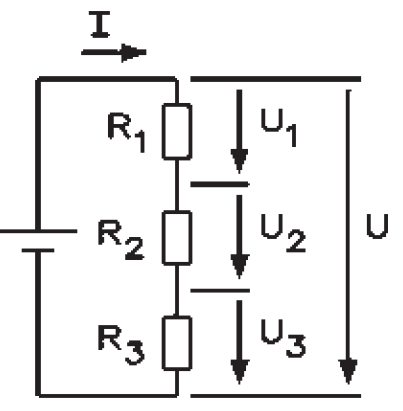
Într-un circuit serie, rezistențele se adună (R_total) și tensiunile se împart proporțional (U_total).
// exemple de utilizare
I Curentul în circuitul seriei în A
U_1, U_2, U_3 Tensiunile parțiale în V
R_1, R_2, R_3 Rezistențele individuale în Ω
R Rezistența totală (suma rezistențelor individuale)
Exemplu: U_1 = 10 V; U_2 = 20 V; U_3 = 30 V; R_1 = 20 Ω; R_2 = 40 Ω; R_3 = 60 Ω; U = ?; R = ?
U = 10 V + 20 V + 30 V = 60 V; R = 20 Ω + 40 Ω + 60 Ω = 120 Ω
U_1, U_2, U_3 Tensiunile parțiale în V
R_1, R_2, R_3 Rezistențele individuale în Ω
R Rezistența totală (suma rezistențelor individuale)
Exemplu: U_1 = 10 V; U_2 = 20 V; U_3 = 30 V; R_1 = 20 Ω; R_2 = 40 Ω; R_3 = 60 Ω; U = ?; R = ?
U = 10 V + 20 V + 30 V = 60 V; R = 20 Ω + 40 Ω + 60 Ω = 120 Ω
// schema electrică
// aceeași categorie
Formule înrudite
- Inductanțe conectate în serie Circuit de curent continuu
- Legea lui Faraday Circuit de curent continuu
- Rezistența magnetică si conductanța magnetică Circuit de curent continuu
- Autoinductia bobinelor Circuit de curent continuu
- Autoinducție (cablu concentric, cablu coaxial) Circuit de curent continuu
- Autoinducție (cablu dublu) Circuit de curent continuu