Circuit de curent continuu
LaTeX
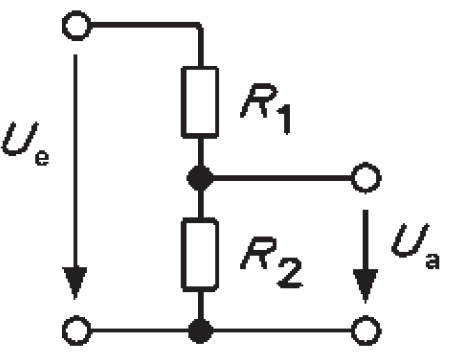
Schemă
Divizorul de tensiune fara sarcina
// formulă randată
// cod LaTeX
\begin{aligned}
& U_{\mathrm{a}}=U_{\mathrm{e}} \cdot \frac{R_2}{R_1+R_2} \\
& R_1=R_2 \cdot\left(\frac{U_{\mathrm{e}}}{U_{\mathrm{a}}}-1\right)
\end{aligned}
// descriere
Un divizor de tensiune neîncărcat împarte tensiunea de intrare (U_e) proporțional între două rezistențe (R_1 și R_2) pentru a obține tensiunea de ieșire (U_a).
// exemple de utilizare
U_e Tensiunea de intrare în V
U_a Tensiunea de ieșire în V
R_1, R_2 Rezistențele individuale în Ω
U_a Tensiunea de ieșire în V
R_1, R_2 Rezistențele individuale în Ω
Exemplu: U_e = 10 V; R_1 = 1 kΩ; R_2 = 2 kΩ; U_a = ?
\( U_{\mathrm{a}}=10 \mathrm{~V} \cdot \frac{2 \mathrm{k} \Omega}{1 \mathrm{k} \Omega+2 \mathrm{k} \Omega}=6,67 \mathrm{~V} \)
\( U_{\mathrm{a}}=10 \mathrm{~V} \cdot \frac{2 \mathrm{k} \Omega}{1 \mathrm{k} \Omega+2 \mathrm{k} \Omega}=6,67 \mathrm{~V} \)
// schema electrică
// aceeași categorie
Formule înrudite
- Inductanțe conectate în serie Circuit de curent continuu
- Legea lui Faraday Circuit de curent continuu
- Rezistența magnetică si conductanța magnetică Circuit de curent continuu
- Autoinductia bobinelor Circuit de curent continuu
- Autoinducție (cablu concentric, cablu coaxial) Circuit de curent continuu
- Autoinducție (cablu dublu) Circuit de curent continuu