Circuit de curent continuu
LaTeX
Schemă
Rezistența și temperatura
// formulă randată
// cod LaTeX
\begin{aligned}
& \Delta R=\alpha \cdot R_{\mathrm{k}} \cdot \Delta \vartheta ; \quad \Delta \vartheta=\frac{R_{\mathrm{w}}-R_{\mathrm{k}}}{R_{\mathrm{k}} \cdot \alpha} \\
& R_{\mathrm{w}}=R_{\mathrm{k}}+\Delta R=R_{\mathrm{k}} \cdot(1+\alpha \cdot \Delta \vartheta)
\end{aligned}
// descriere
Relația dintre rezistență și temperatură arată cum variază rezistența unui material conductor în funcție de schimbarea temperaturii.
// exemple de utilizare
ΔR Schimbarea rezistenței în Ω
R_k Rezistența la rece la 20 °C în Ω
R_w Rezistența la cald în Ω
α Coeficientul de temperatură în 1/K
Δϑ Schimbarea de temperatură
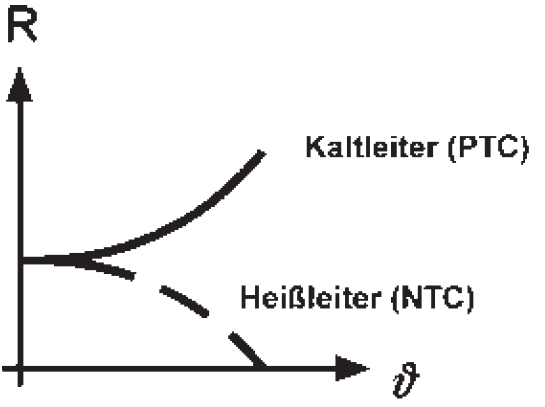
NTC Coeficient de temperatură negativ
PTC Coeficient de temperatură pozitiv
Exemplu: \( R_{\mathrm{k}}=100 \Omega ; \Delta \vartheta=50 \mathrm{~K} ; \alpha=0,004 \mathrm{~K}^{-1} ; R_{\mathrm{w}}=? \)
\( R_{\mathrm{w}}=100 \Omega \cdot\left(1+0,004 \frac{1}{\mathrm{~K}} \cdot 50 \mathrm{~K}\right)=120 \Omega \)
R_k Rezistența la rece la 20 °C în Ω
R_w Rezistența la cald în Ω
α Coeficientul de temperatură în 1/K
Δϑ Schimbarea de temperatură
NTC Coeficient de temperatură negativ
PTC Coeficient de temperatură pozitiv
Exemplu: \( R_{\mathrm{k}}=100 \Omega ; \Delta \vartheta=50 \mathrm{~K} ; \alpha=0,004 \mathrm{~K}^{-1} ; R_{\mathrm{w}}=? \)
\( R_{\mathrm{w}}=100 \Omega \cdot\left(1+0,004 \frac{1}{\mathrm{~K}} \cdot 50 \mathrm{~K}\right)=120 \Omega \)
// schema electrică
// aceeași categorie
Formule înrudite
- Inductanțe conectate în serie Circuit de curent continuu
- Legea lui Faraday Circuit de curent continuu
- Rezistența magnetică si conductanța magnetică Circuit de curent continuu
- Autoinductia bobinelor Circuit de curent continuu
- Autoinducție (cablu concentric, cablu coaxial) Circuit de curent continuu
- Autoinducție (cablu dublu) Circuit de curent continuu